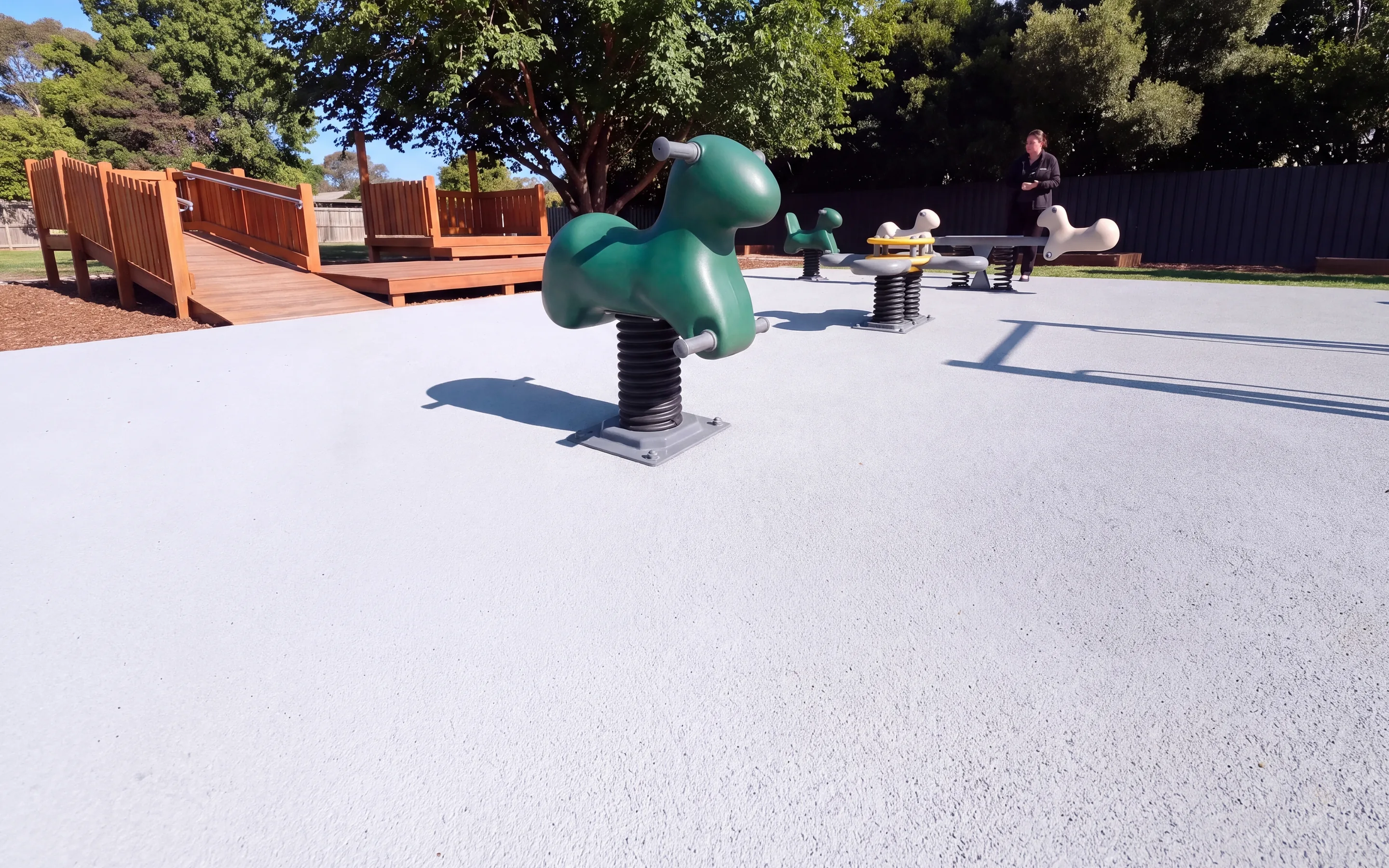
Spring Riders and Playground SeesawsRocking Equipment for Toddler and Preschool Areas
Every spring bolts to a removable base plate over a cast-in anchor plate, so it is changed without breaking concrete.
- Springs changed without breaking concrete
- Rubber pinch-guard sleeve over the full coil
- Rock-and-return check on every piece · on video
- Rotomolded · colored through the wall
Spring Rider and Seesaw RangeSingle, Two-Seat and Four-Seat Riders, Beam and Spring Seesaws
Commercial spring riders and playground seesaws for toddler areas, preschool yards and park play zones. Every piece has a rotomolded LLDPE body or seat from our rotomolding workshop, carries its own K part number, and belongs to our commercial playground equipment line.
Parks departments, childcare centers and preschools, community and residential developments, dealers and installers order rockers for a 2–5 zone, a toddler room yard or the gaps between larger play structures, either for an existing playground or with a full outdoor order.
- Two-part base · anchor plate + removable base plate
- Pivot post footing · classic seesaws
Seesaw beams are part of our Ø114 mm galvanized, powder-coated steel system; seats and handles are rotomolded LLDPE. Every piece goes on the same layout, footing drawings and container plan as the rest of the outdoor order.
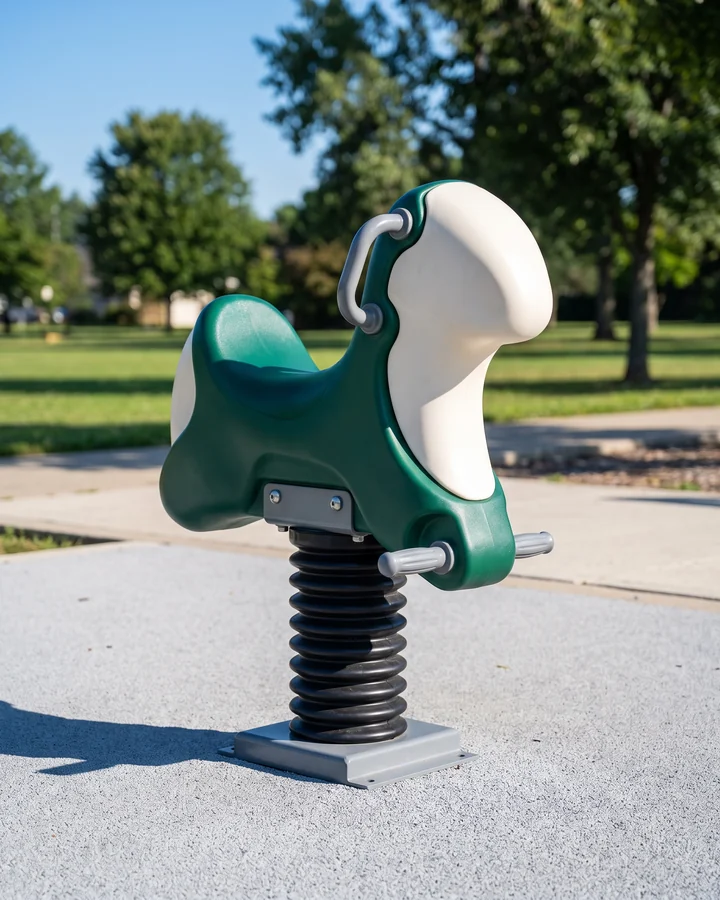
Single-seat spring riders
One rotomolded body on one spring, with handles and molded footrests.
Seats · 1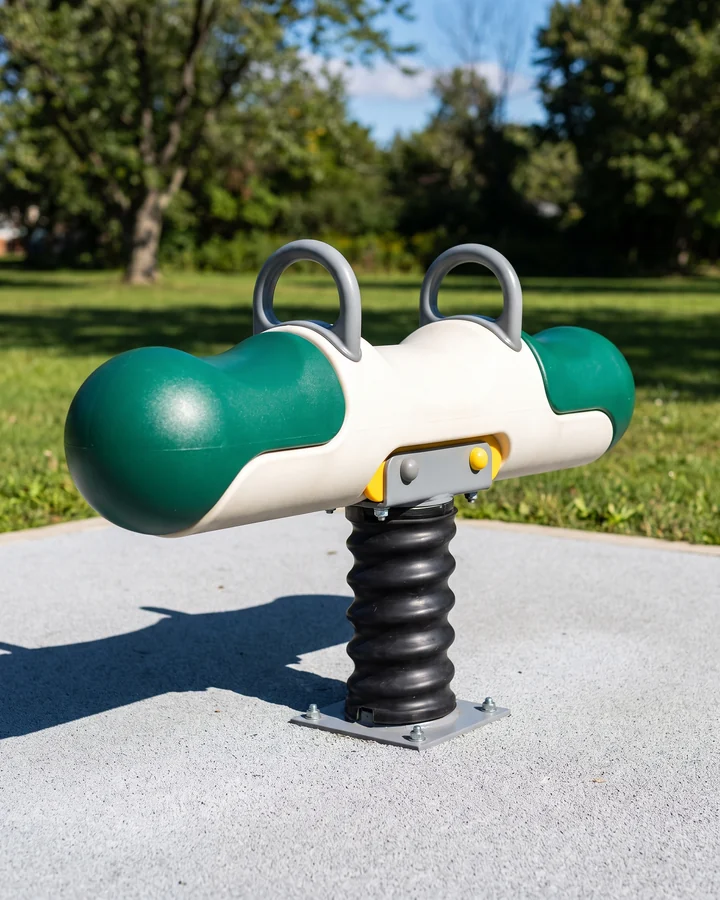
Two-seat spring riders
One body with two seats on one spring.
Seats · 2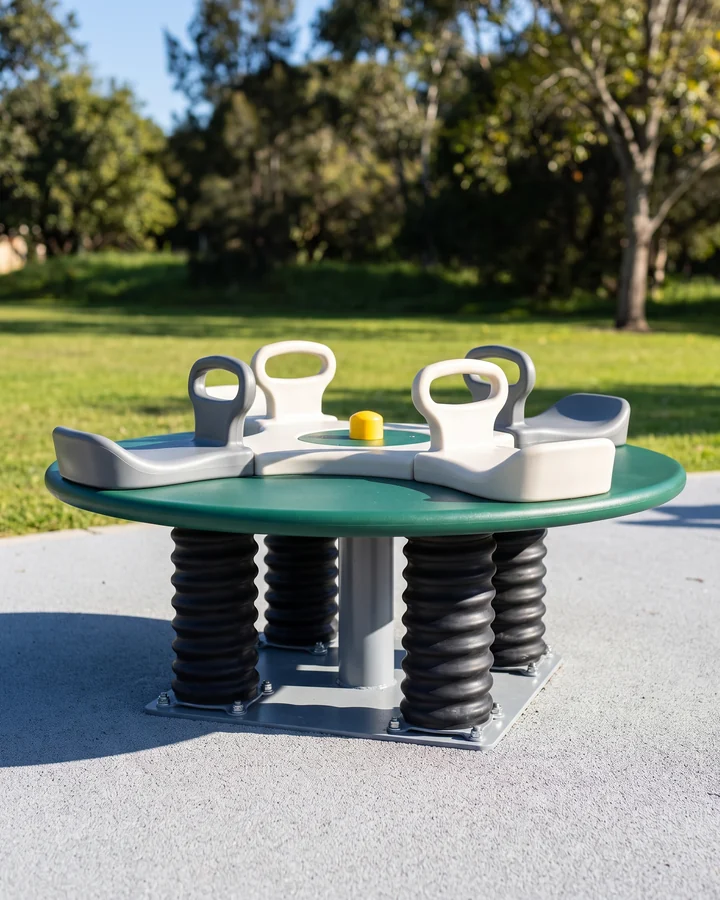
Four-seat spring riders
A platform or cross-shaped body on multiple springs.
Seats · small group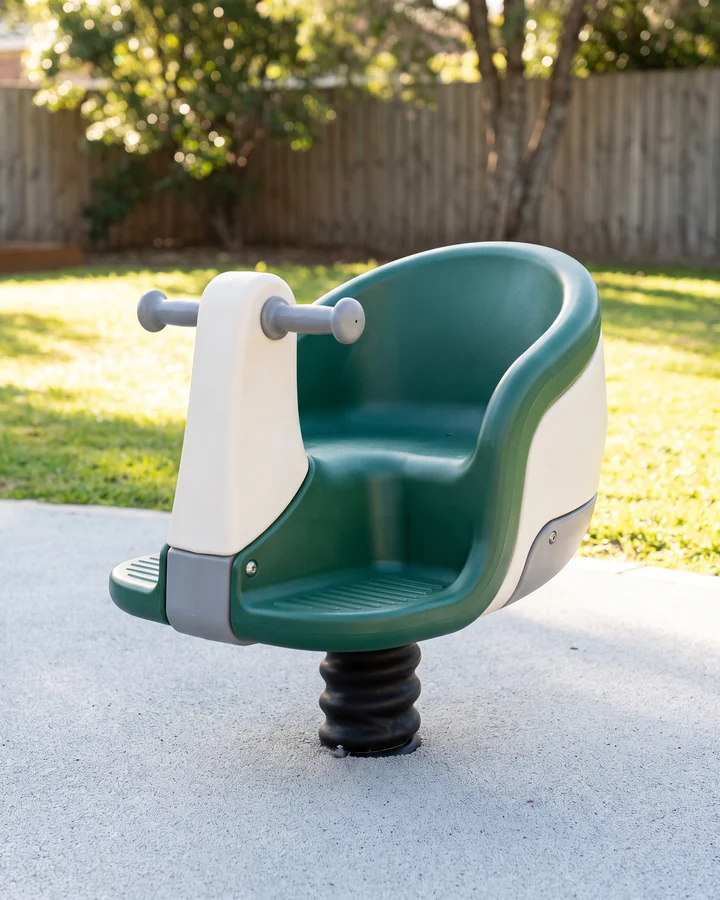
Low-seat spring riders
A backrest or wraparound seat, for 2–5 zones and toddler rooms.
Seats · 1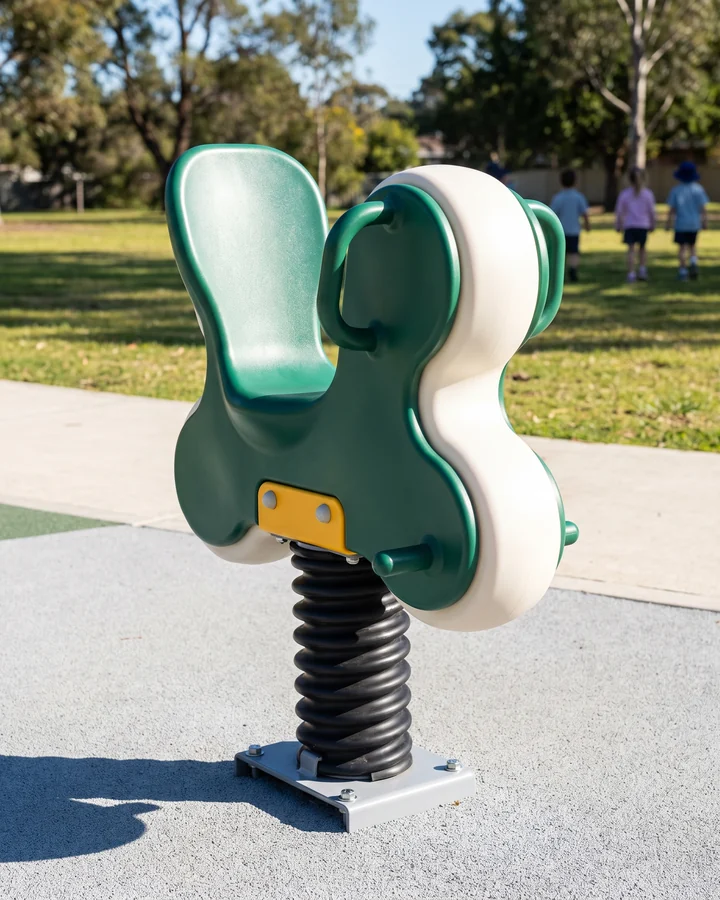
High-back inclusive riders
A high-back seat with handles, for children who need more support.
Seats · 1
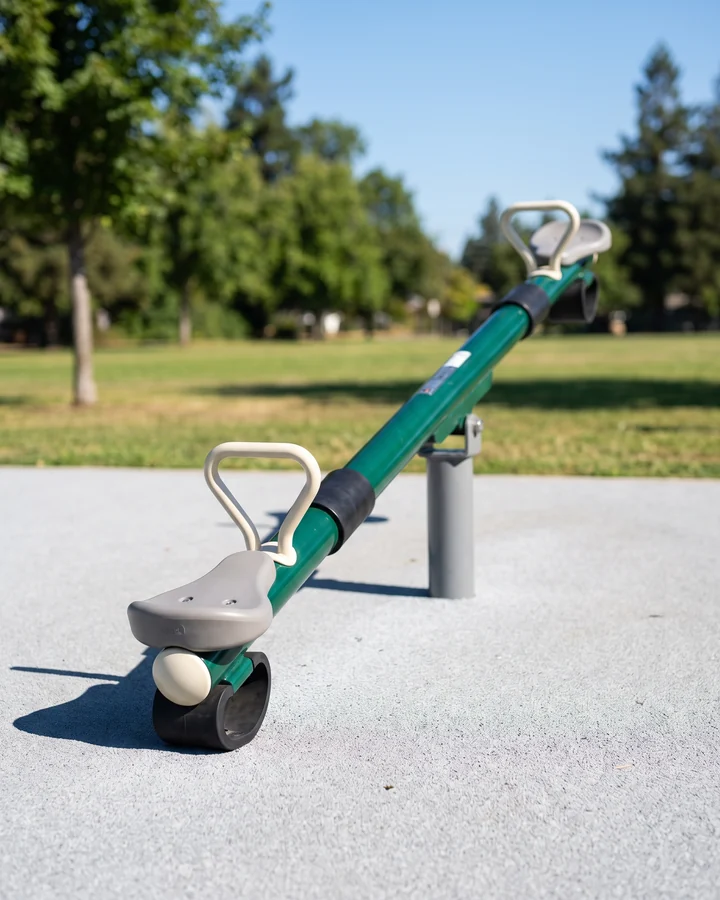
Classic beam seesaws
Two seats on a steel beam turning on a center pivot, rubber bumpers under each seat end.
Seats · 2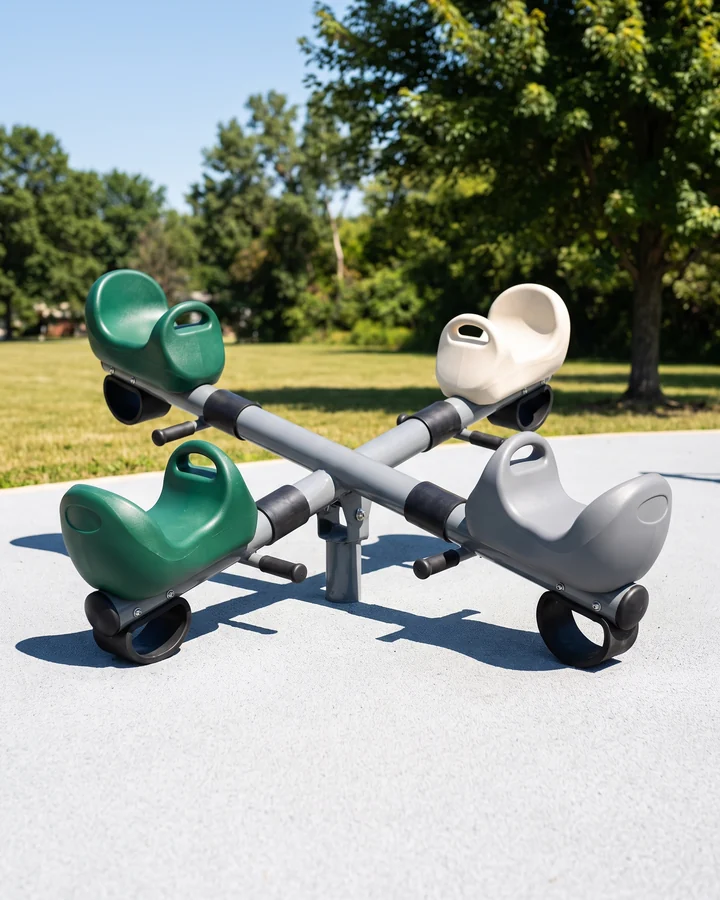
Four-seat seesaws
A double or cross beam with four seats on one pivot.
Seats · 4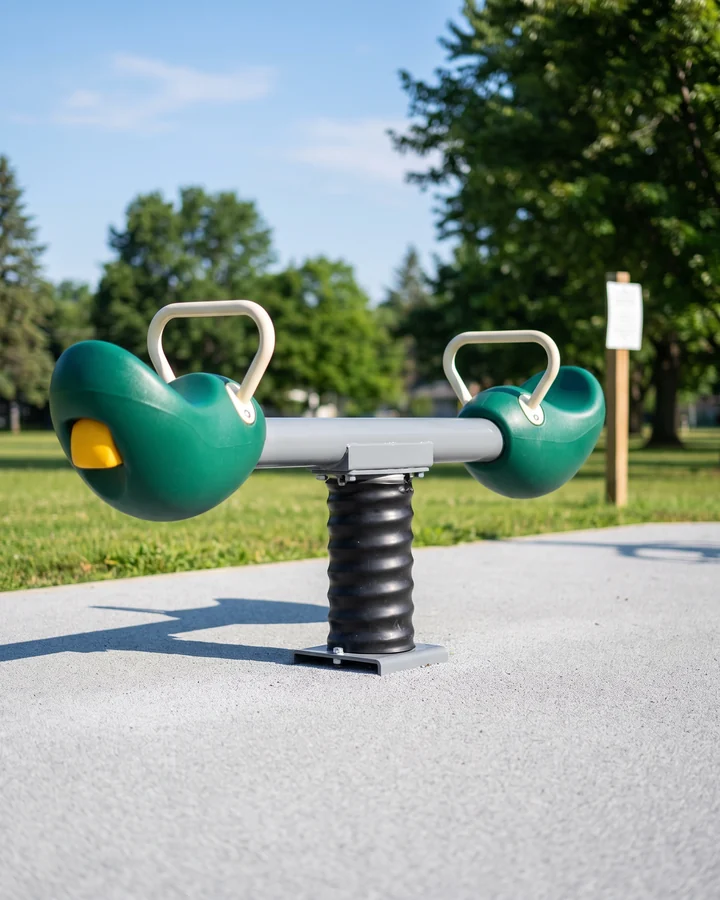
Spring seesaws
A beam on a center spring that returns itself to level.
Seats · 2 or more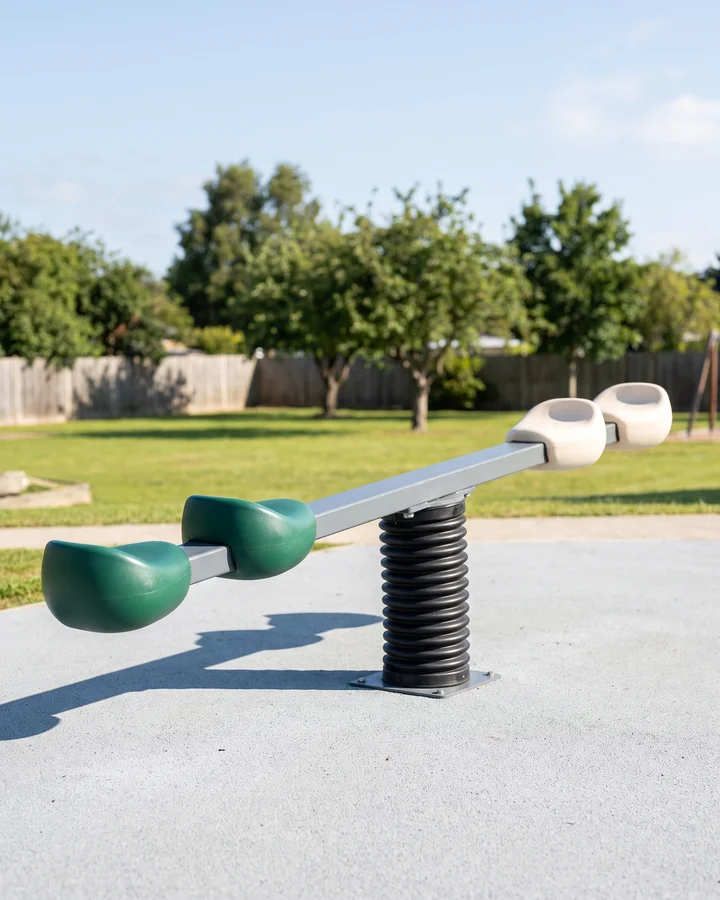
Multi-seat spring seesaws
A longer or cross beam on a center spring.
Seats · 2 or more
Spring Rider and Seesaw Selection by Age Zone and SiteToddler Rooms, 2–5 and 5–12 Zones, Slabs and Rooftops
Rockers are drawn into the zone they serve, to ASTM F1487 and the CPSC handbook, or to EN 1176 where your project names it.
At a childcare center, zones are drawn as the center director assigns each room. Every piece carries a manufacturer label and an age-range label. Full toddler yards are on preschool and daycare playground equipment.
Riders at once
A single-seat rider gives one child a turn. Two-seat and four-seat riders and seesaws are for pairs and small groups. On a spring seesaw, the center spring brings the beam back to level between pushes.
Support
Where the playground serves children who need a seat with more support, a high-back inclusive rider goes near the accessible route.
Ground
On soil, a rocker stands on a concrete footing with a cast-in anchor plate. On slabs and rooftops, small freestanding pieces take a surface-mount base plate, with the fixing confirmed by your structural engineer.
What you get
Each piece on your layout with its K number, and a single-item plan and elevation. Item dimensions and seat heights are on each item's data sheet.
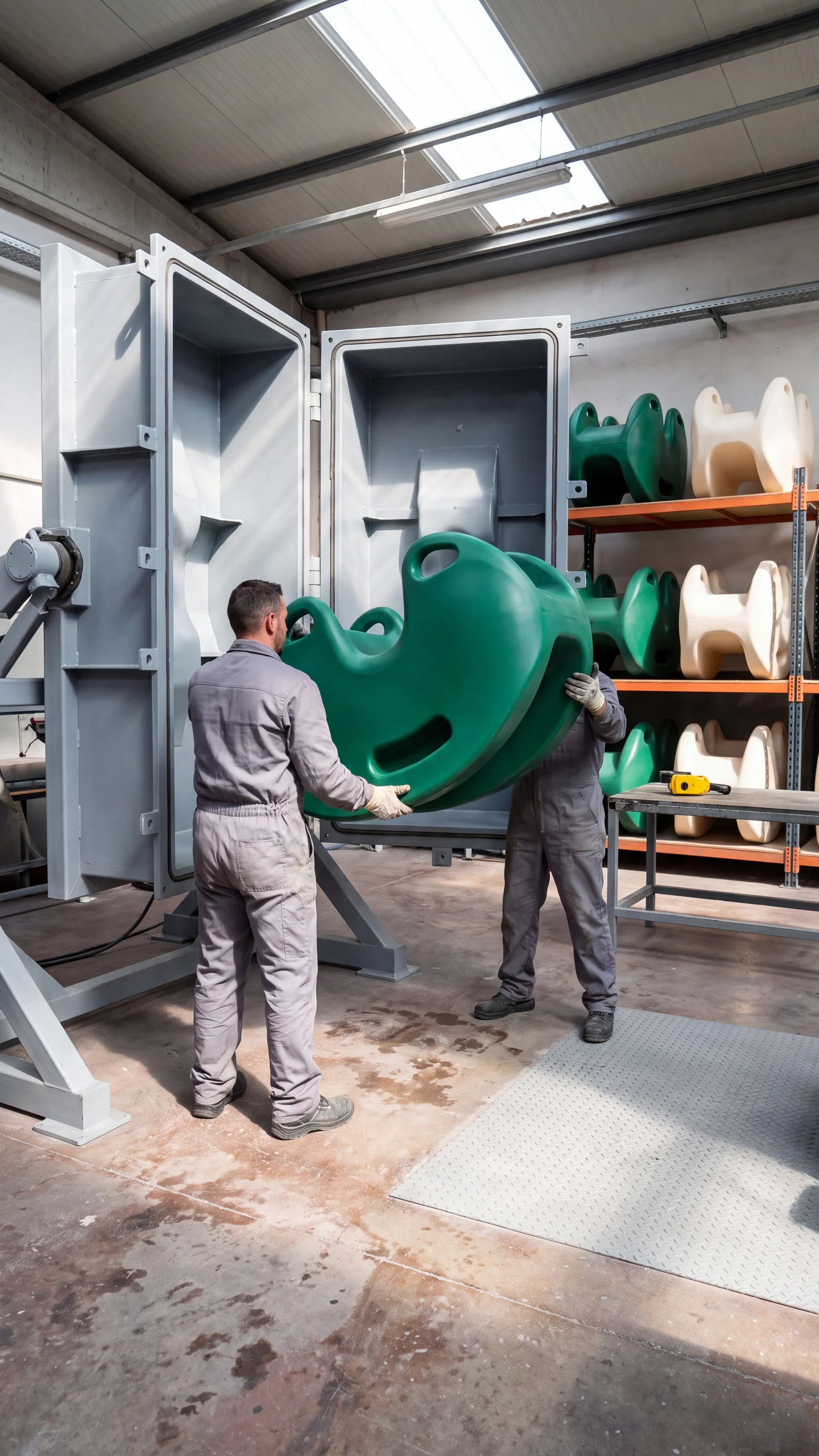
Rotomolded BodiesOur Own Molds, Colored Through the Wall, Trimmed and Drilled In-House
Spring rider bodies, seesaw seats and handles are made in our workshop from UV-stabilized LLDPE, in our own steel molds.RotomoldingResin goes into a closed steel mold that turns on two axes while it heats, so the plastic coats every wall of the shape in one seamless piece.
-
01 · Molding
Two axes while it heats
The mold turns on two axes while it heats, so the resin coats every wall of the shape, then cools in the mold before the body comes out. The full process is on playground equipment manufacturing.
-
02 · Color through the wall
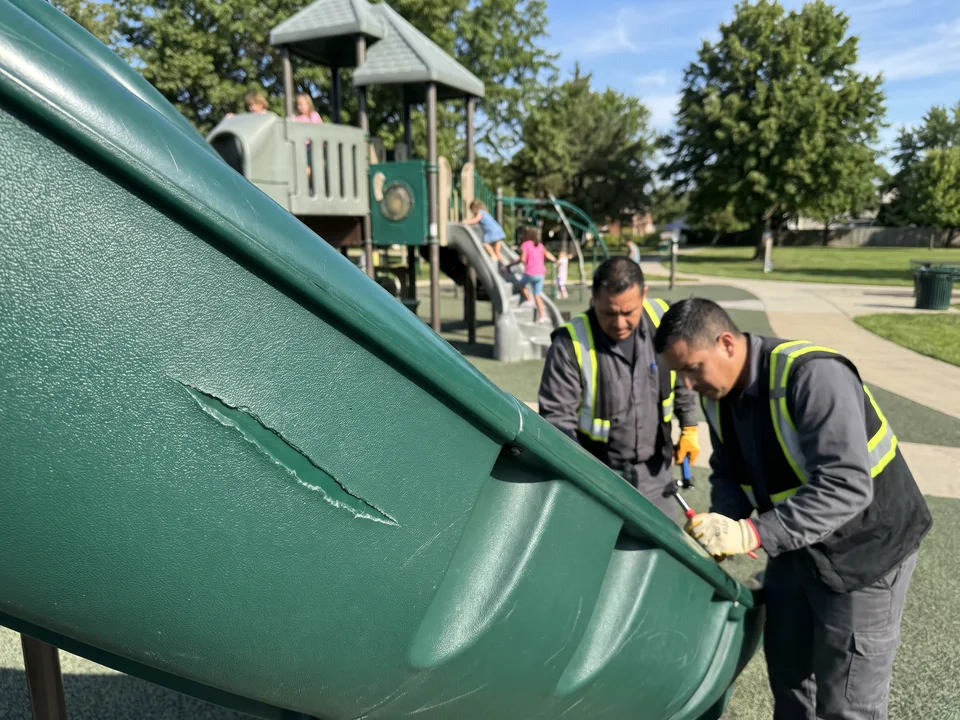 Scratch · same color below
A scratch shows the same color
The resin is colored all the way through, so a scratch on a rider shows the same color as the surface around it. Standard color range, or custom colors on request.
-
03 · Trimming and drilling
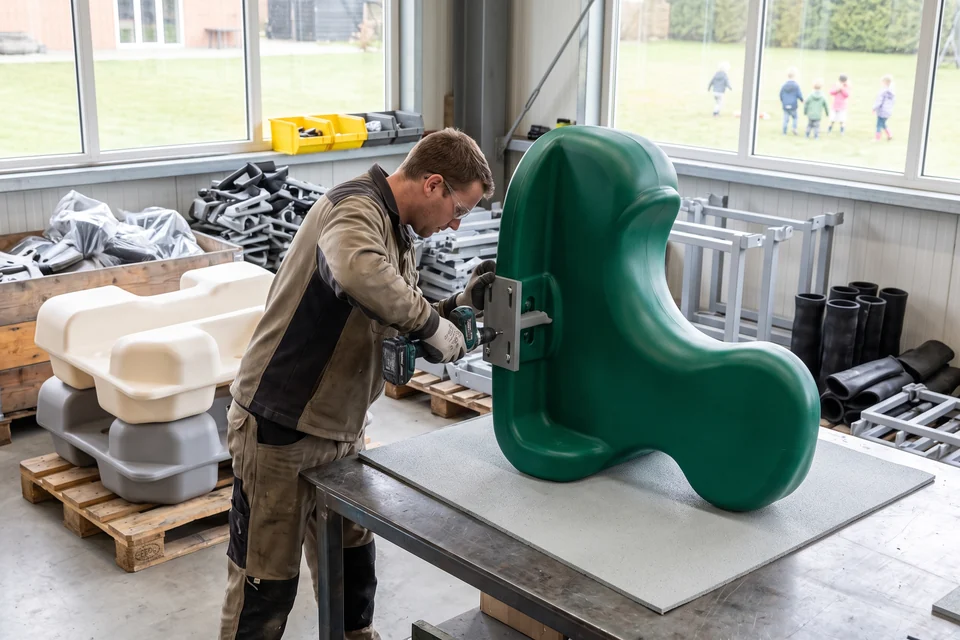
Holes drilled where the steel lines up
Each body is trimmed and drilled for its fixings in the rotomolding workshop: the holes for the spring set insert and the handles, so the steel parts line up when they are bolted on.
-
04 · Handles and footrests
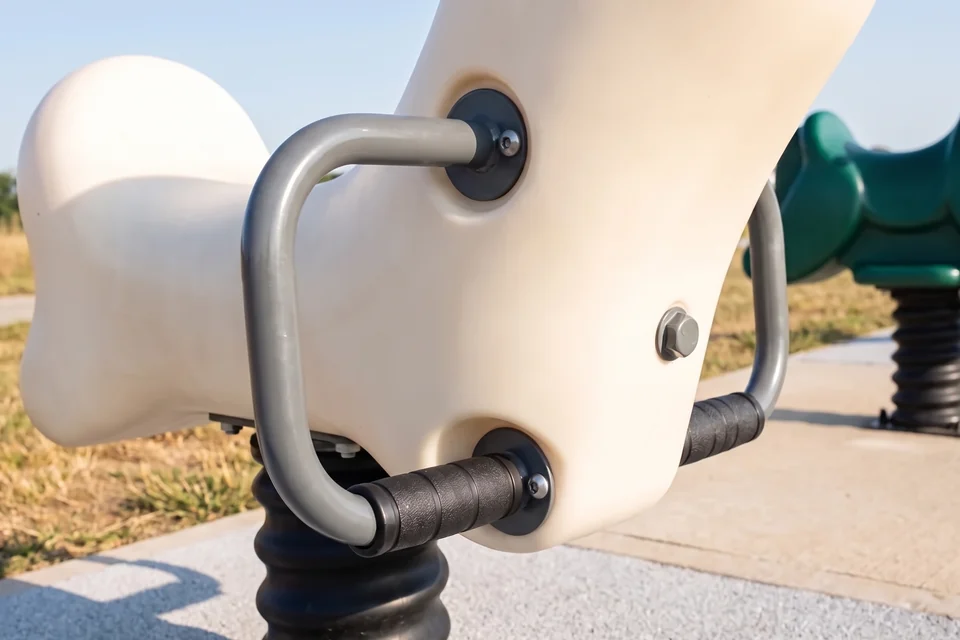
Handles bolted through the body
Steel handles are powder coated, fitted with grips and bolted through the body, so a handle can be replaced on its own. Footrests are molded into the body.
Warranty on rotomolded bodies and seats.
Spring Rider ConstructionSpring Set, Pinch-Guard Sleeve and Two-Part Base
A spring rider is built from five parts, bolted together from the footing up.
The body bolts to its spring set through steel connection plates and 304 stainless tamper-resistant bolts; the spring set bolts down to a removable base plate, and that plate bolts to an anchor plate cast into the concrete footing.
- 1
Anchor plateA steel plate with bent anchors, cast into the concrete footing. It stays in the ground for the life of the rider.
A steel anchor plate is cast into the concrete footing. Your local installer pours the footing to our footing detail drawing, which gives the footing size and anchor plate position for each piece.
Stays in the concrete - 2
Removable base plate
A steel base plate bolts onto the anchor plate. This is the part that makes the base two-part: the anchor plate stays in the concrete, and everything above it can come off.
The part that makes the base two-part - 3
Spring set
A heavy-duty coil spring in spring steel with an anti-corrosion coating, with a steel connection plate at the top and the bottom. The bottom plate bolts to the base plate with 304 stainless steel .Tamper-resistant boltA bolt head that needs a matching security bit to turn. The bits ship in the spare hardware kit with every order.
K1-002 · on your part list - 4
Pinch-guard sleeveA rubber sleeve over the full length of the coil, so no gap between the coils is open to fingers while the rider rocks.
A rubber sleeve covers the full length of the coil, so fingers cannot reach between the coils as the rider rocks.
- 5
Body
The top connection plate bolts to an insert in the rotomolded body with 304 stainless steel tamper-resistant bolts, capped.
Four-seat riders and spring seesaws
Four-seat riders use the same parts, with multiple spring sets under one platform or cross body, each on the same two-part base. Spring seesaws stand on the same two-part base, with the beam fixed to the top plate of the center spring.
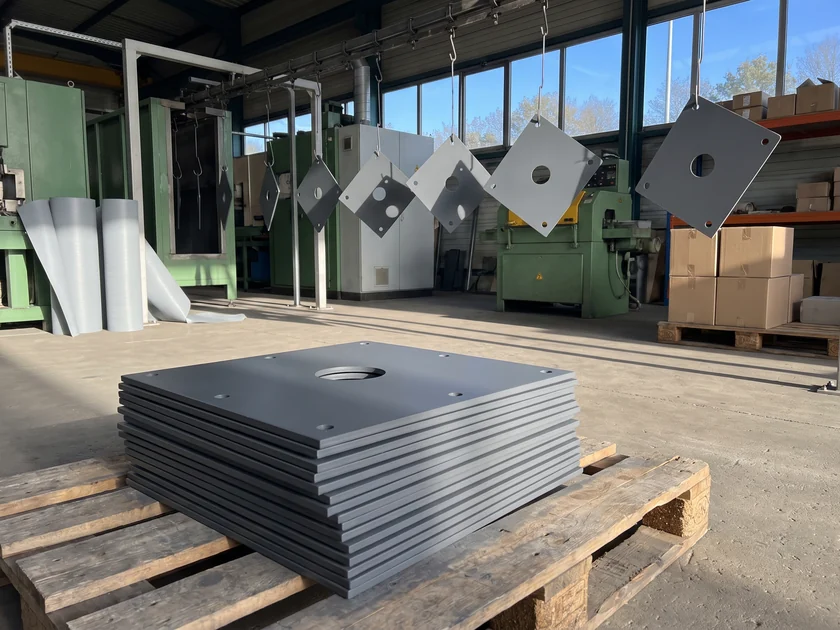
Base plates
Steel base plates are made in our steel fabrication workshop, hot-dip galvanized and powder coated like the rest of our outdoor steel. Springs carry a 2-year warranty as moving parts, and steel base plates 10 years.
Assembly drawing
Every part in the stack is on the assembly drawing with its part number and bolt sizes, and torque values are marked on the drawing, so the rider goes together on site in the same order it was built.
1 Anchor plate (cast in) · 2 Removable base plate · 3 Spring set K1-002 · 4 Pinch-guard sleeve · 5 Body. Bolt sizes and torque values are marked on your project's assembly drawing.
Spring ReplacementCast-In Anchor Plate, Removable Base Plate and K Part Numbers
A spring is the part of a spring rider that works every time a child rocks. The rider is built so the spring set is a part you replace, while the footing and anchor plate stay in the ground.
When a spring wears, your maintenance crew unbolts the old spring set and fits a new one ordered by its K number, and the footing stays as it is.
- Left: with the spring set cast straight into the footing, as many rockers are still installed, a worn spring means cutting the surfacing, breaking out the concrete and pouring a new footing.
- Right: on our two-part base, the concrete footing, the anchor plate cast into it and the surfacing around it are never disturbed. The body goes back on the new spring.
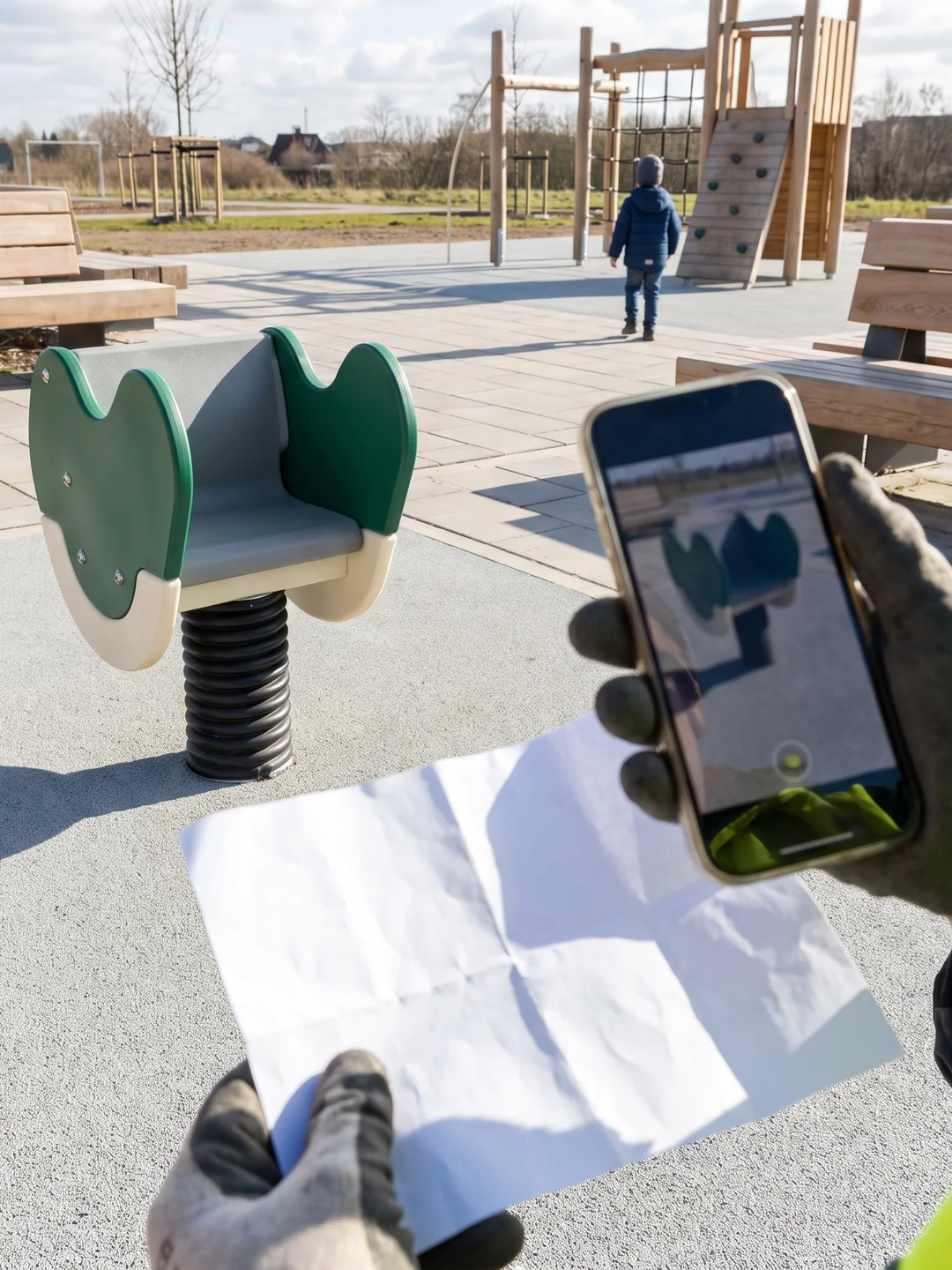
What you order
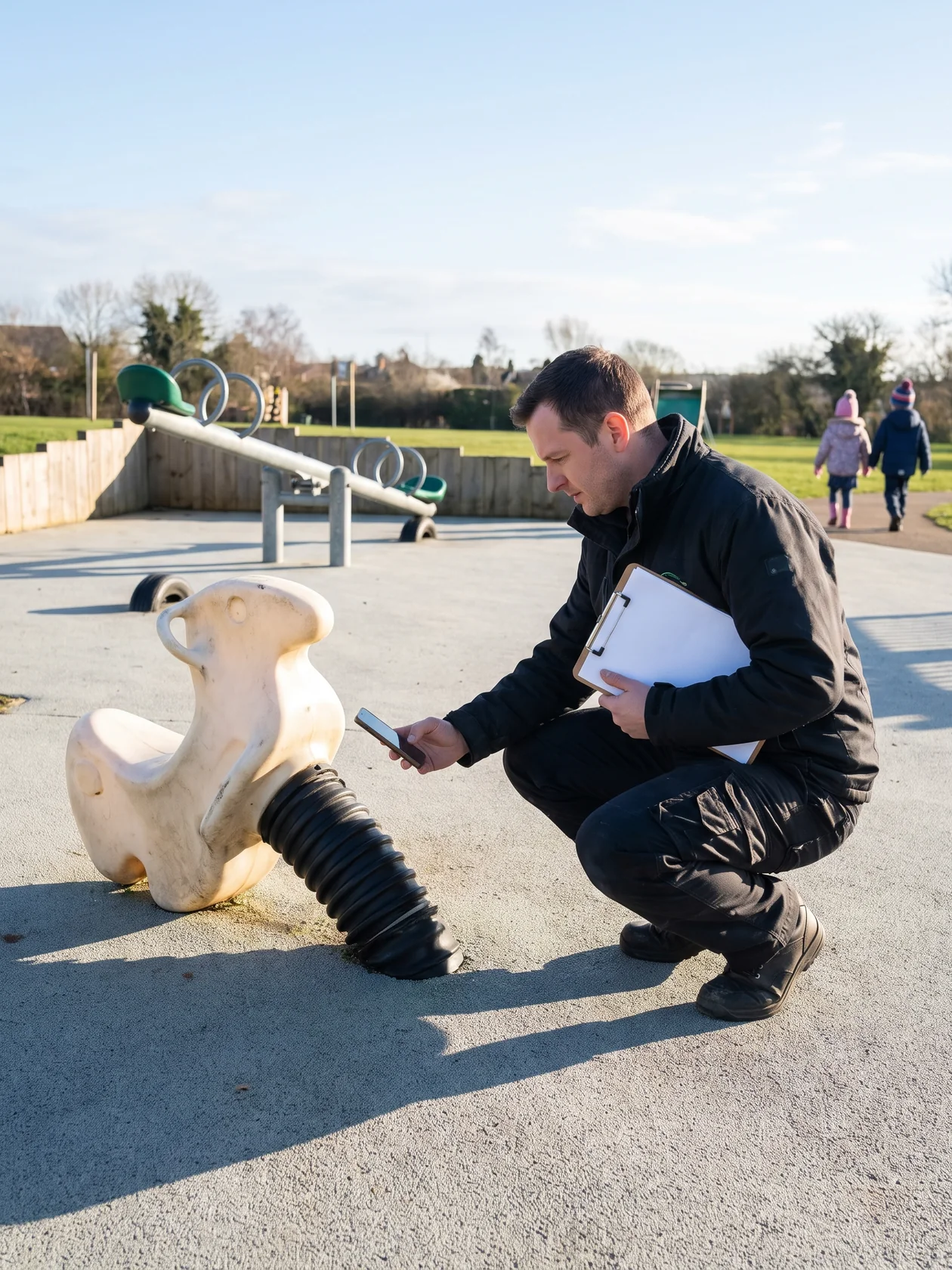
Every spring set has its own part number on your part list and packing list, such as K1-002. Send a photo of the rider and the part number. QC confirms it against your project part list, and a new spring set is made to the same number. Spare parts can be ordered by part number at any time.
Tools
Security bits for the tamper-resistant heads ship in the spare hardware kit with every order, with the tool list on the drawings. If your crew gets stuck, send photos and part numbers and we take a WhatsApp video call booked to your working hours.
Other replaceable parts
Handles, seesaw bumpers and seesaw pivots have their own K part numbers too, and are ordered the same way.
- K1-004 · handle
- K4-006 · bumper
- K4-007 · pivot
What your crew does
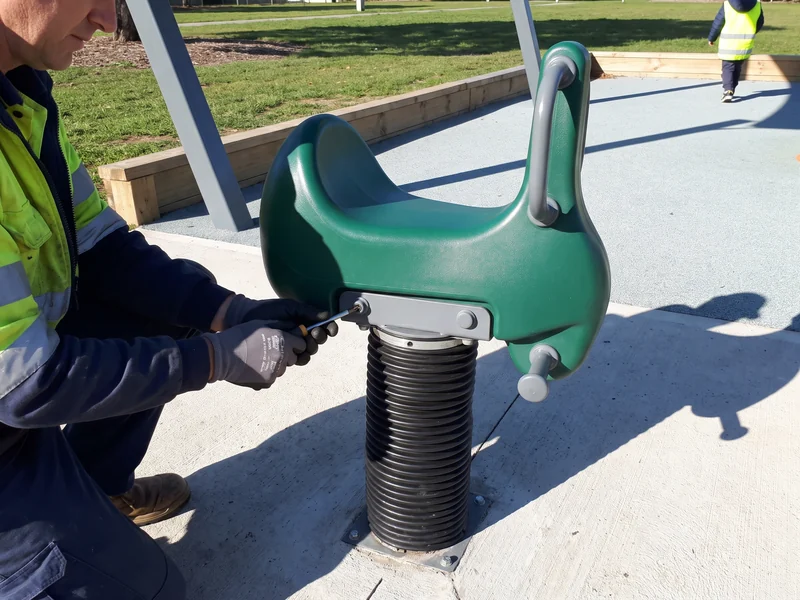 1
1Body off
Remove the bolts between the body and the top connection plate, and lift the body off.
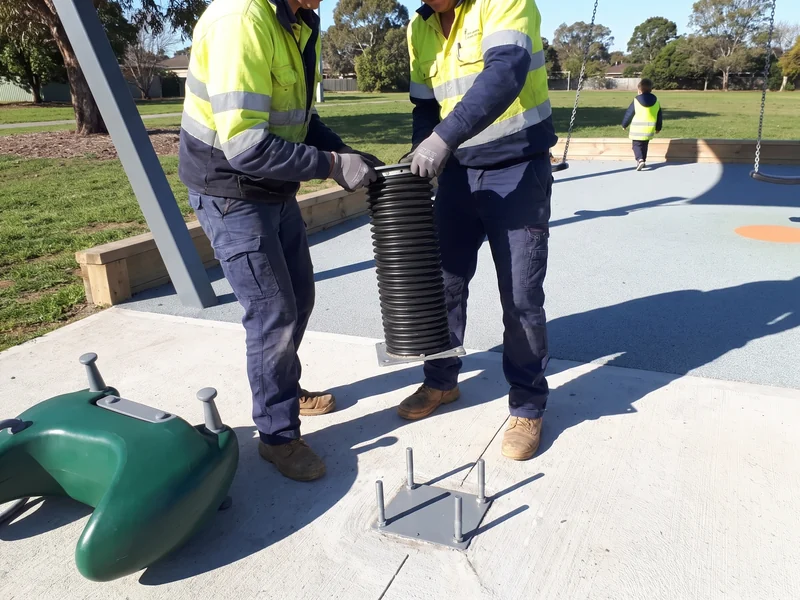 2
2Old spring set out
Remove the bolts between the removable base plate and the anchor plate, and lift out the old spring set with its base plate.
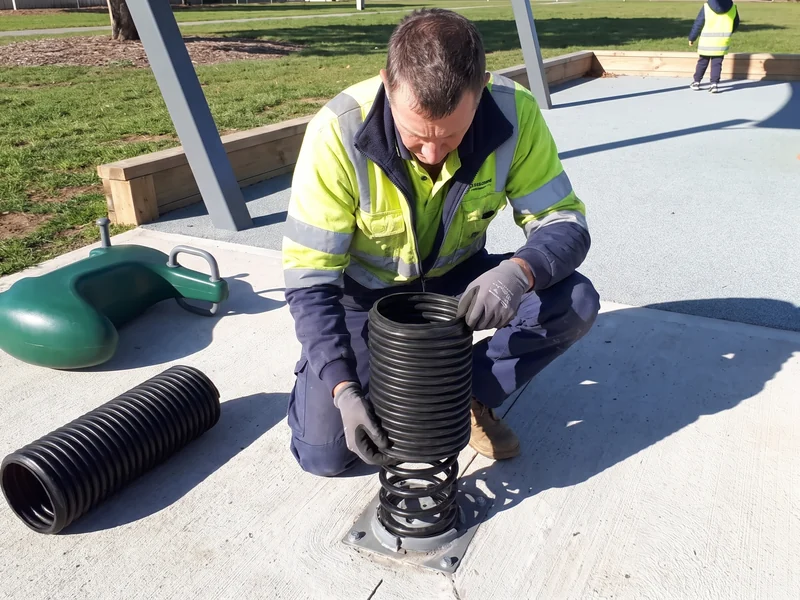 3
3New spring set in
Set the new spring set in place, bolt its base plate to the anchor plate, and fit the pinch-guard sleeve over the coil.
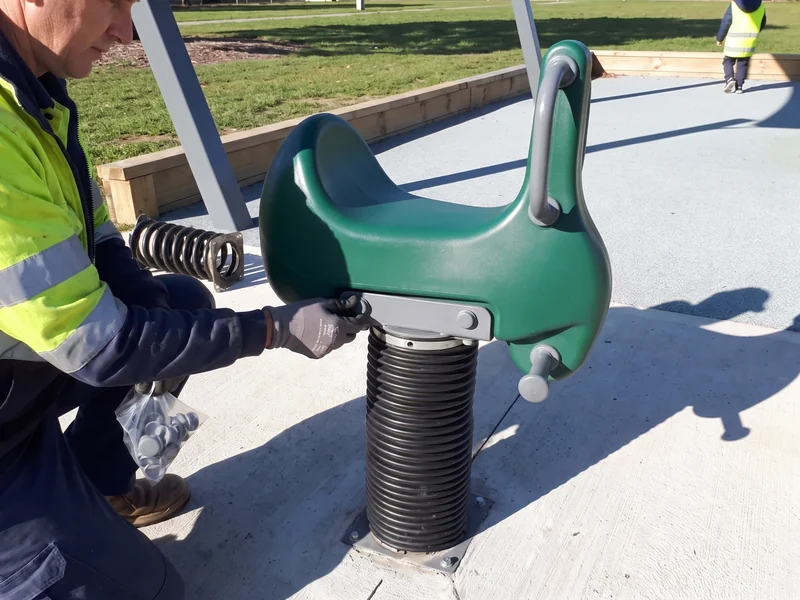 4
4Body back on
Bolt the body back onto the top plate with the same 304 tamper-resistant bolts.
- 5 yrsRotomolded body and seats
- 2 yrsSpring set · a moving part, like pivots and bumpers
- 10 yrsSteel base plate, and seesaw beams
- StaysAnchor plate, cast into your footing
Warranty, part by part
Springs, pivots and bumpers are moving parts, with a 2-year warranty. Rotomolded bodies carry 5 years, and steel base plates and beams 10 years. Warranty terms sit in each quotation; how quotations are put together is on playground equipment cost.
Seesaw Pivot and BumpersSealed Bearing Pivot, Rubber Bumpers and Spring-Centered Beams
Seesaws come in two families, and they handle the up-and-down movement in two different ways. The beam, seats and handles are the same; what sits under the middle of the beam is not.
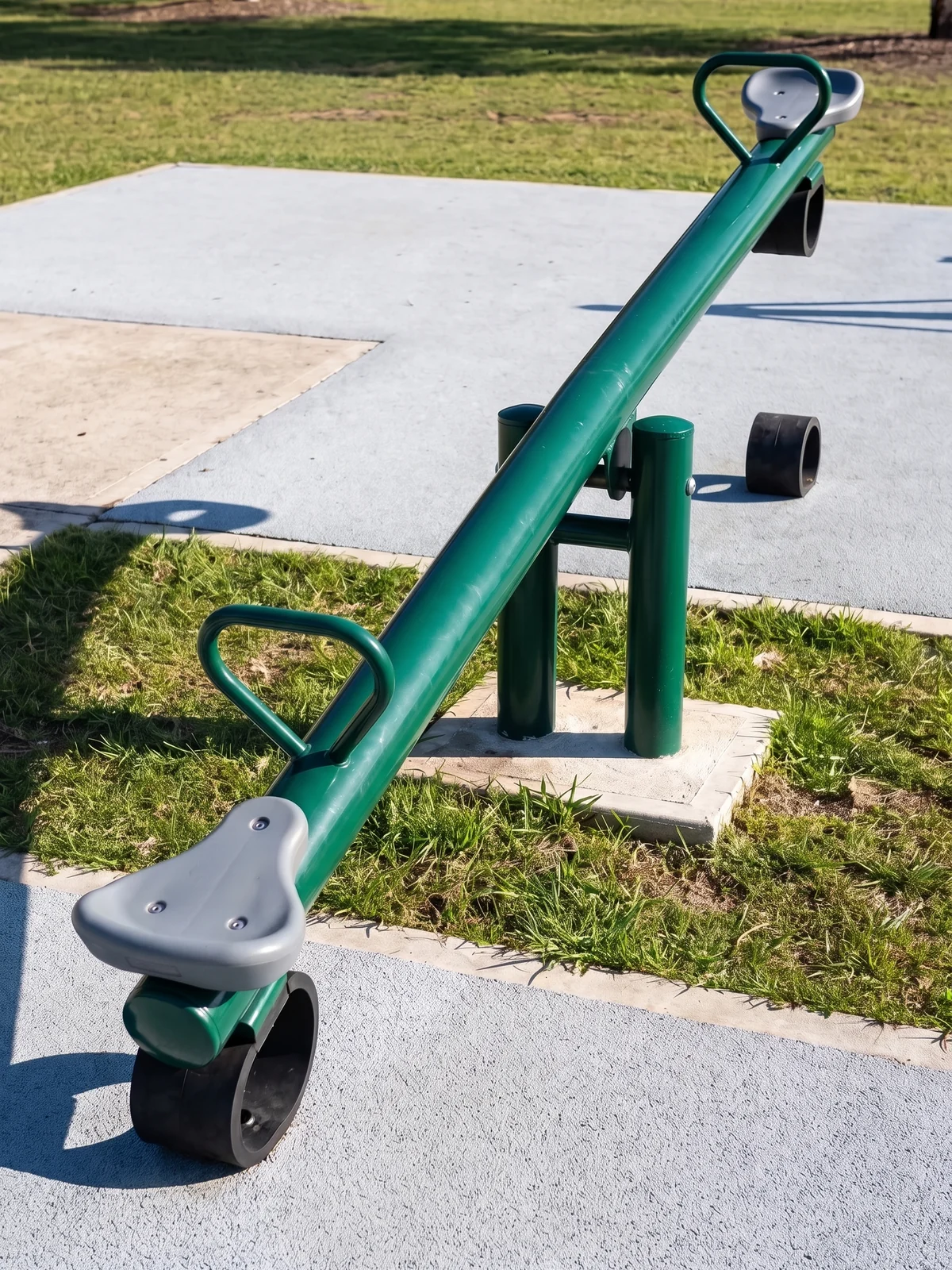
Classic beam seesaws
Two seats on a steel beam in our Ø114 mm galvanized, powder-coated system.
The beam turns on a at its center, so it moves smoothly and the bearing stays closed to sand and water. Four-seat seesaws use a double or cross beam on the same kind of pivot.Sealed bearing pivotThe bearing the beam turns on is enclosed in its housing, so sand and rain do not get into it.
Rubber bumpers
Under each seat end sits a rubber bumper. When a seat comes down, it lands on the bumper. Each bumper has its own K part number and bolts in place, so your crew replaces a worn bumper without touching the beam.
Spring seesaws
The beam rests on a center spring set, on the same two-part base as our spring riders.
The spring limits how far each end travels and returns the beam to level on its own, so the ends never land hard.
Multi-seat spring seesaws use a longer or cross beam on the same kind of center spring, under a full-length pinch-guard sleeve.
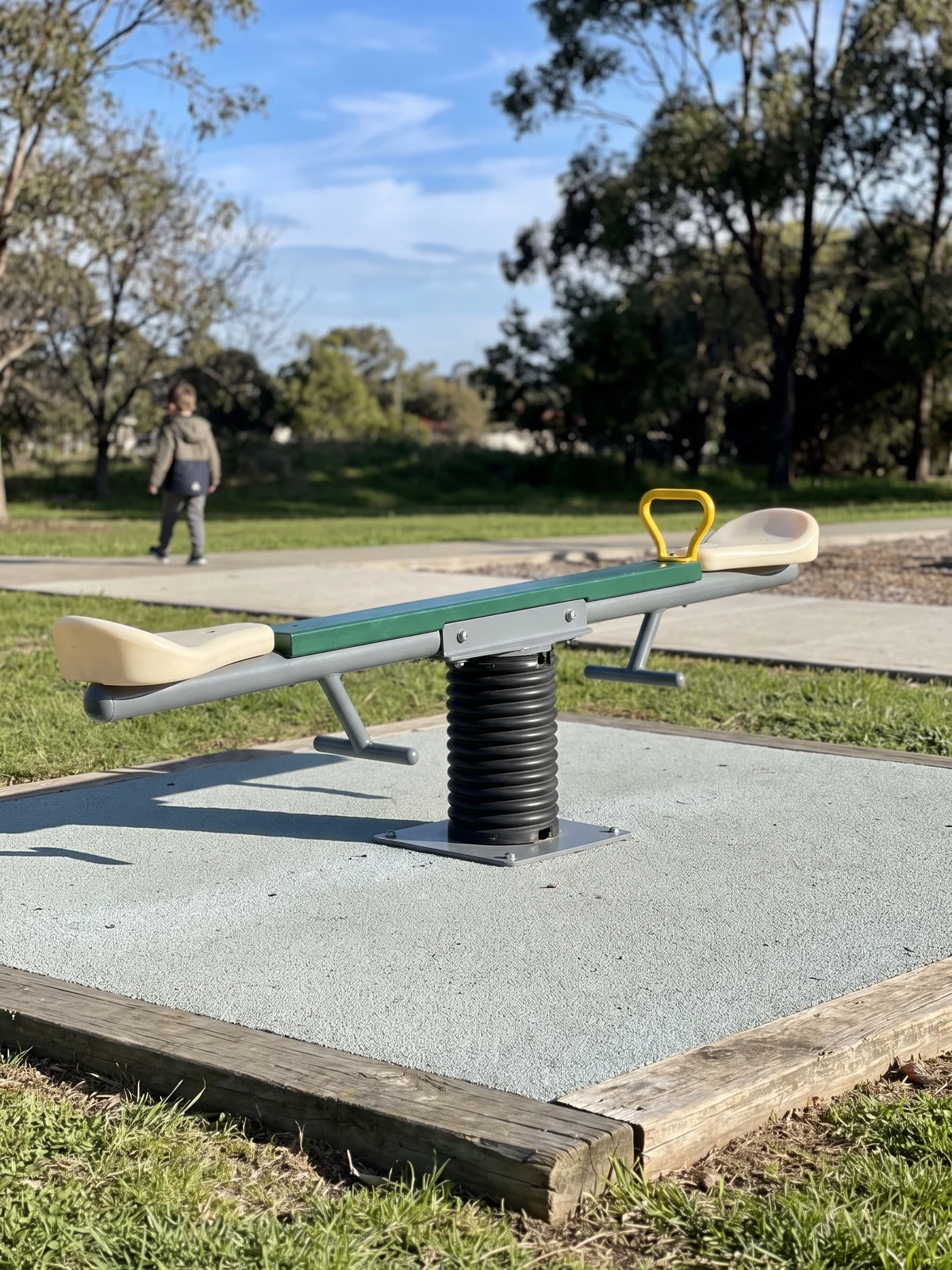
Seats and handles
Seats and handles are rotomolded LLDPE from our rotomolding workshop, colored through the wall, and bolted to the beam with 304 stainless steel tamper-resistant fasteners, capped.
Footing
Each seesaw stands on the footing given on the footing detail drawing: the pivot post for classic seesaws, the anchor plate for spring seesaws.
What you get
Each seesaw on your layout with its use zone, a single-item plan and elevation, and the pivot, bumpers and spring set on the part list with their own numbers.
Factory Rock-and-Return CheckEvery Spring Rider and Seesaw Assembled and Filmed Before Packing
Every spring rider and seesaw is made to your approved drawing, like the rest of your outdoor order. Nothing is pulled from a warehouse shelf, and before packing, every piece is assembled with its spring set and checked.
- Handles bolted through
- Bolt caps fitted
- Footrests · no sharp edges
- Seats · no sharp edges
When
After the body has been trimmed and drilled in the rotomolding workshop and the steel parts are coated, the piece is assembled with its spring set: body, top plate, spring set, sleeve and base plate, bolted as they will be on site.
Who
The check is done and signed by our QC team, separate from the rotomolding and steel workshops that made the parts.
What is checked
- Rock-and-return: the rider is pushed over and must come back upright on its own. Seesaws are checked for smooth turning on the pivot, bumper seating under each seat end, and, on spring seesaws, the beam returning to level.
- Sleeve fit: the rubber sleeve covers the full coil, with no coil left exposed.
- Fixings: handles bolted through the body, bolt caps fitted, footrests and seats free of sharp edges.
If a check fails
The part is corrected in the factory, the piece is assembled again and the check is repeated before it is taken apart.
What you get
A video of your own pieces going through the check, then taken apart, with each part numbered and packed against a packing list keyed to part numbers.
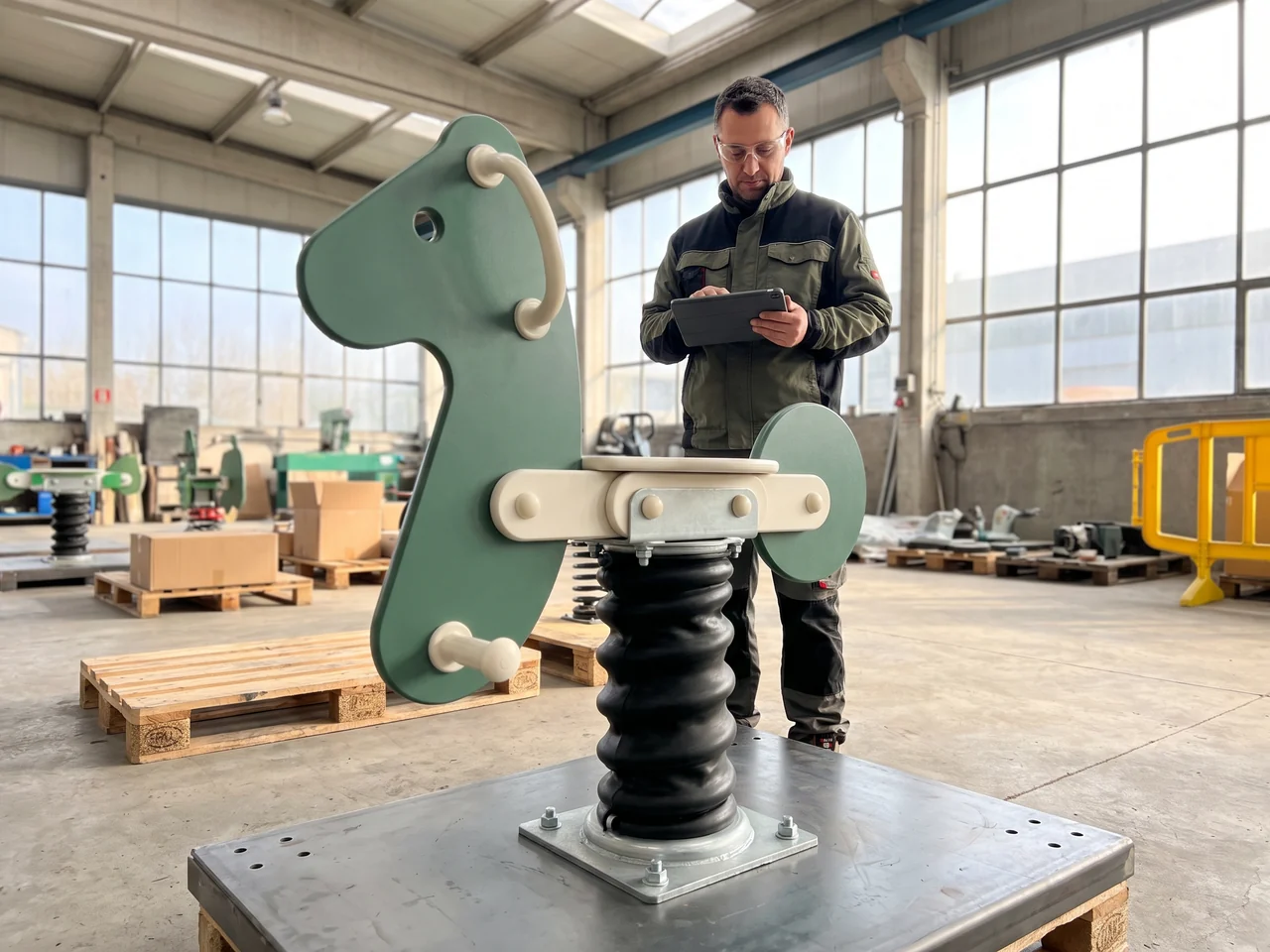 Assembled
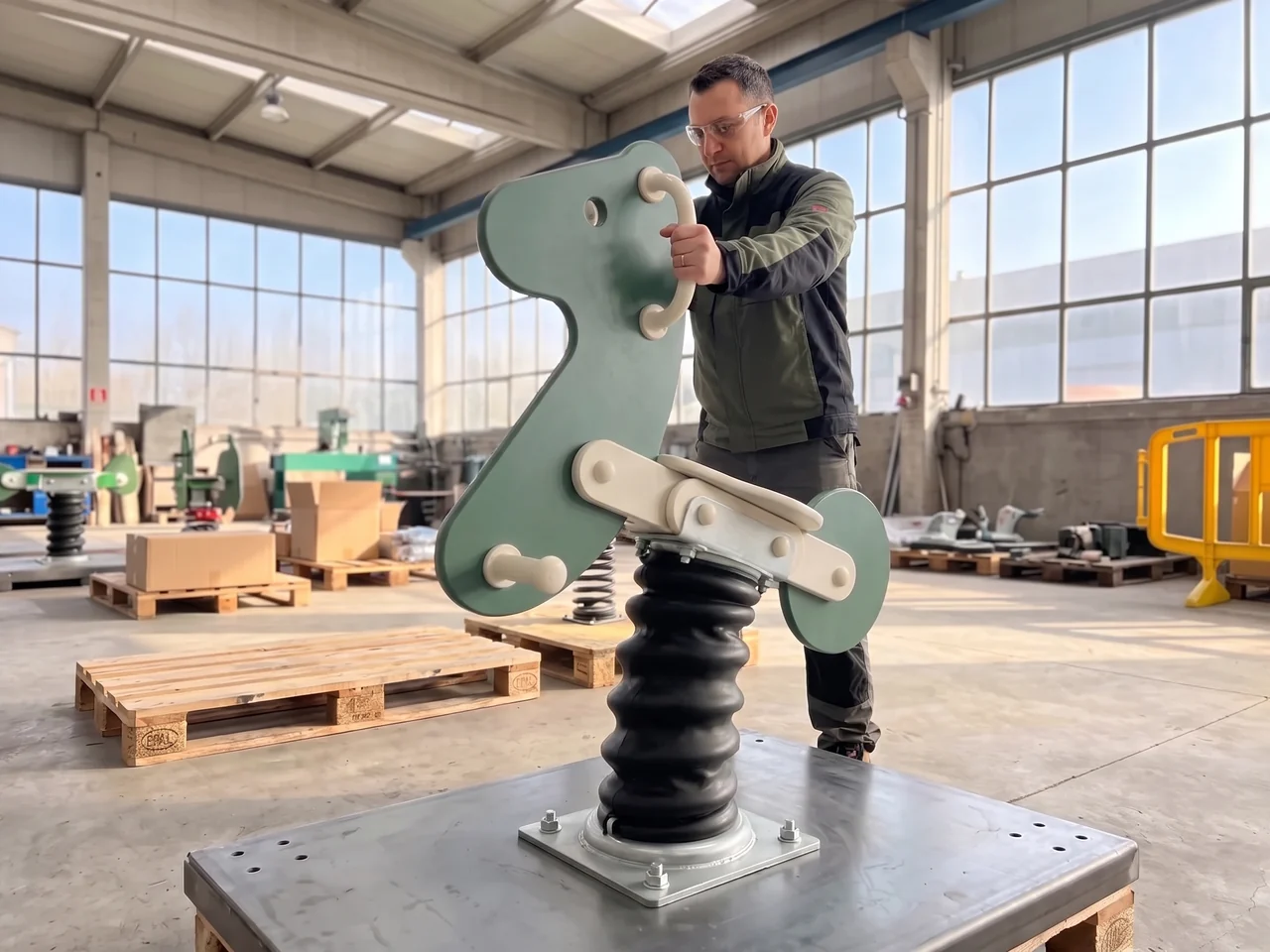 Pushed over
Spring Rider and Seesaw ComparisonSingle, Two-Seat, Four-Seat, Beam and Spring Seesaws
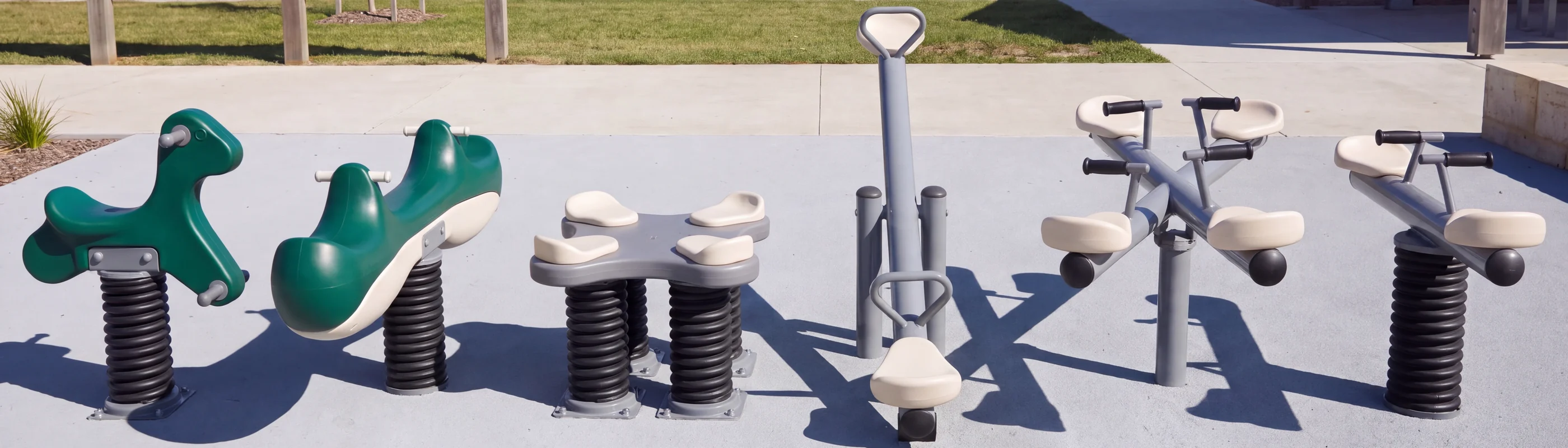
| Form | Single-seat rider | Two-seat rider | Four-seat rider | Classic beam seesaw | Four-seat seesaw | Spring seesaw |
|---|---|---|---|---|---|---|
| Riders | One child | Two children | Small group | Two children | Four children | Two or more |
| Movement | Rocking on one spring | Rocking on one spring | Rocking on multiple springs | Up and down on a sealed bearing pivot | Up and down on a sealed bearing pivot | Up and down on a center spring, self-centering |
| Cushioning | Pinch-guard sleeve over the coil | Pinch-guard sleeve | Pinch-guard sleeves | Rubber bumpers under each seat end | Rubber bumpers | Spring-limited travel |
| Base | Anchor plate + removable base plate | Anchor plate + removable base plate | Two-part base under each spring | Pivot post footing | Pivot post footing | Anchor plate + removable base plate |
| Age zone | 2–5, low-seat for toddler rooms | 2–5 and 5–12 | 2–5 and 5–12 | 2–5 and 5–12 | 2–5 and 5–12 by size | 2–5 and 5–12 by size |
K numberSend your site plan and the age zones for your rockers.
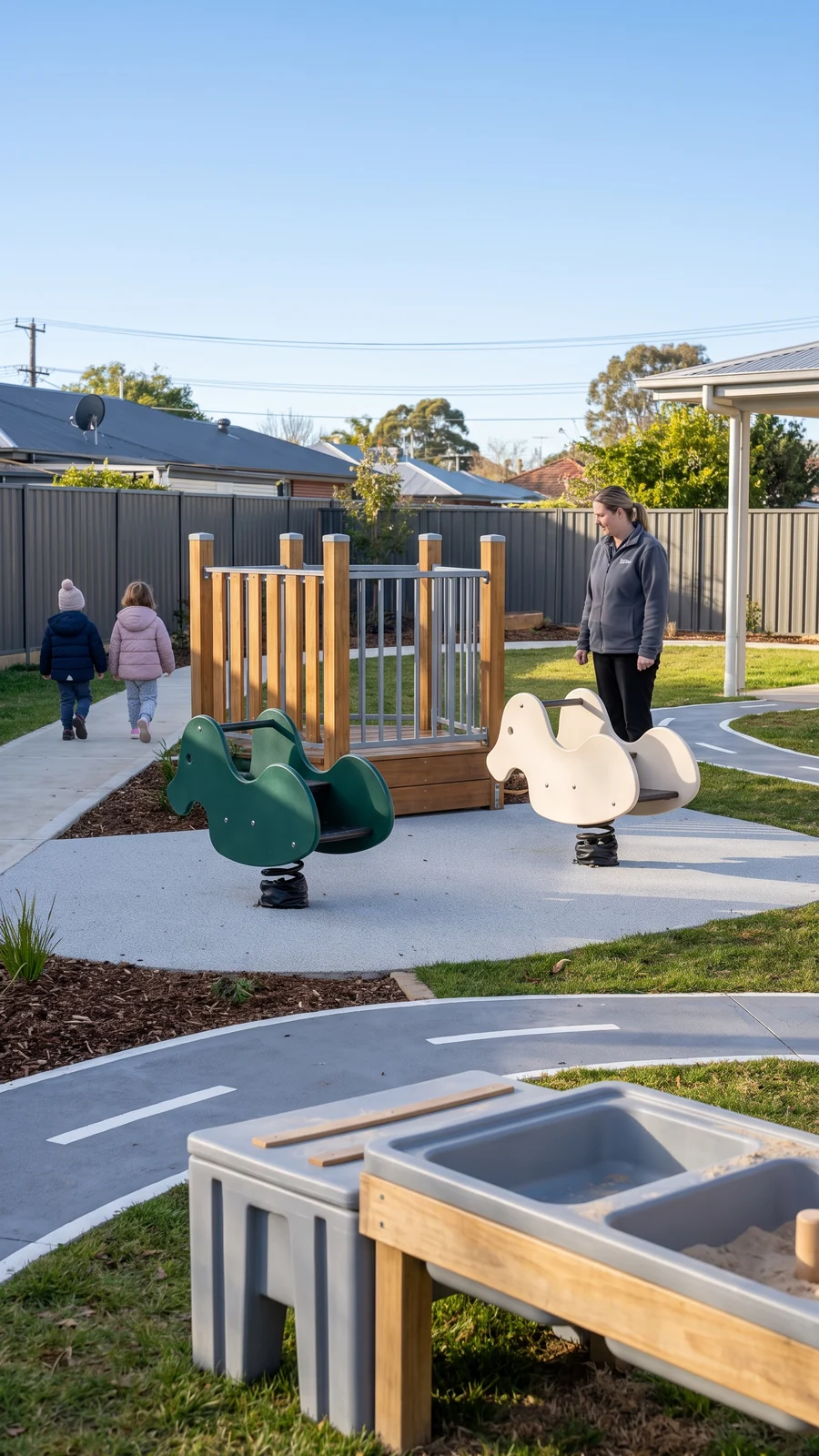
Low-Seat Spring Riders for Toddler Rooms and Preschool AreasBackrests, Wraparound Seats and Surface-Mount Bases
Low-seat riders have a backrest or a wraparound seat that holds the child on both sides, with handles in front and footrests molded into the body. The seat height of each model is on its data sheet.
Zones
Toddler rooms are drawn into the 2–5 zone by default, with the center director deciding each room's zone. Low-seat riders go in the zone the director assigns, and each carries its age-range label.
High-back inclusive riders
A high-back seat with handles, for children who need more support, placed near the accessible route. Accessible routes and other inclusive pieces are on inclusive playground equipment.
Where they stand
Our layouts place spring riders where staff can see them from their marked positions on the drawing, next to the low-deck structure, sand and water tables and trike path. Every rider is reachable by staff from the ground.
For a group of centers, one standard center layout becomes a site drawing for each center, with the same part numbers and colors, so riders and springs are reordered on the same project file. Full toddler and preschool play yards are on preschool and daycare playground equipment.
On slabs and rooftops
Many centers have play yards on a slab or a rooftop. Low-seat riders can be ordered with a surface-mount base plate, fixed as your structural engineer confirms, with the same removable spring set above it.
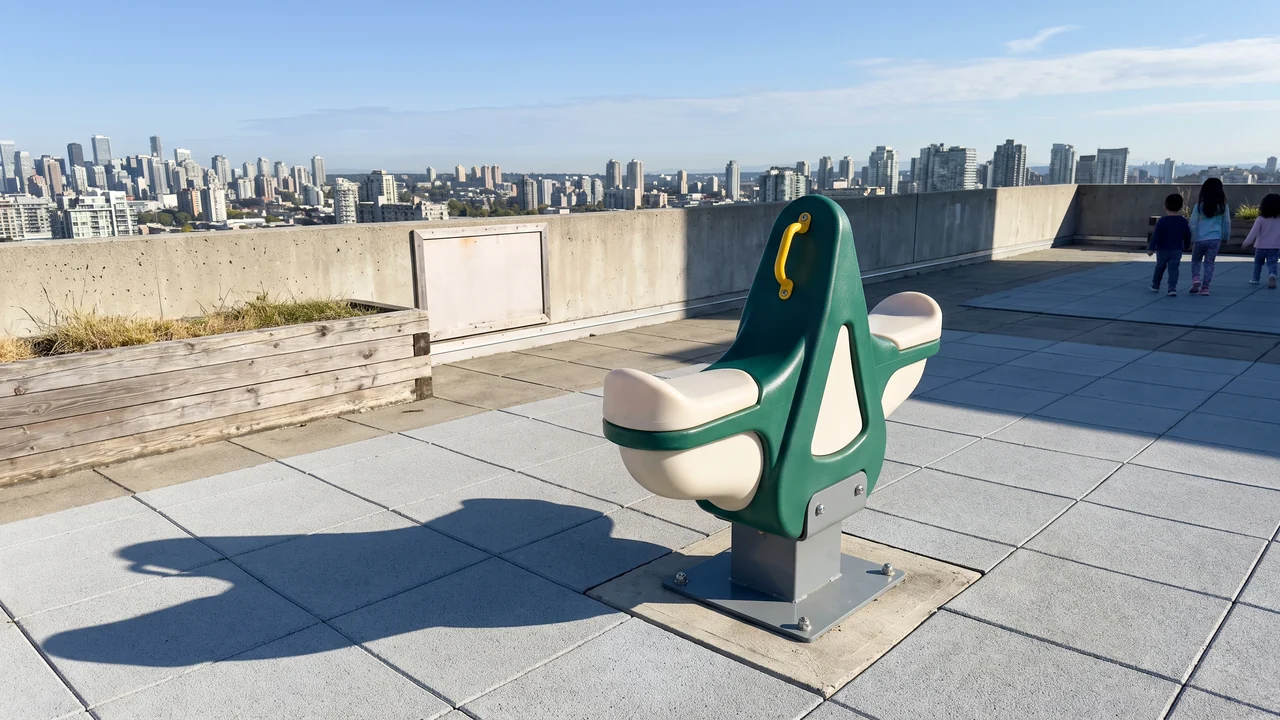
Spring Rider OptionsMold Shapes, Colors, Inclusive High-Back Seats and Dealer Decals
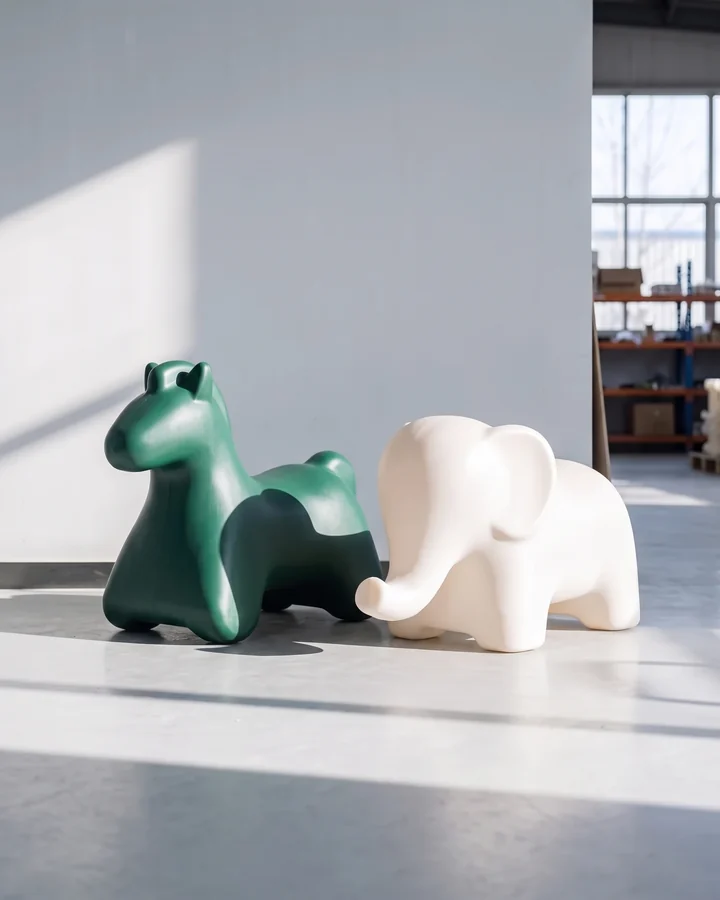
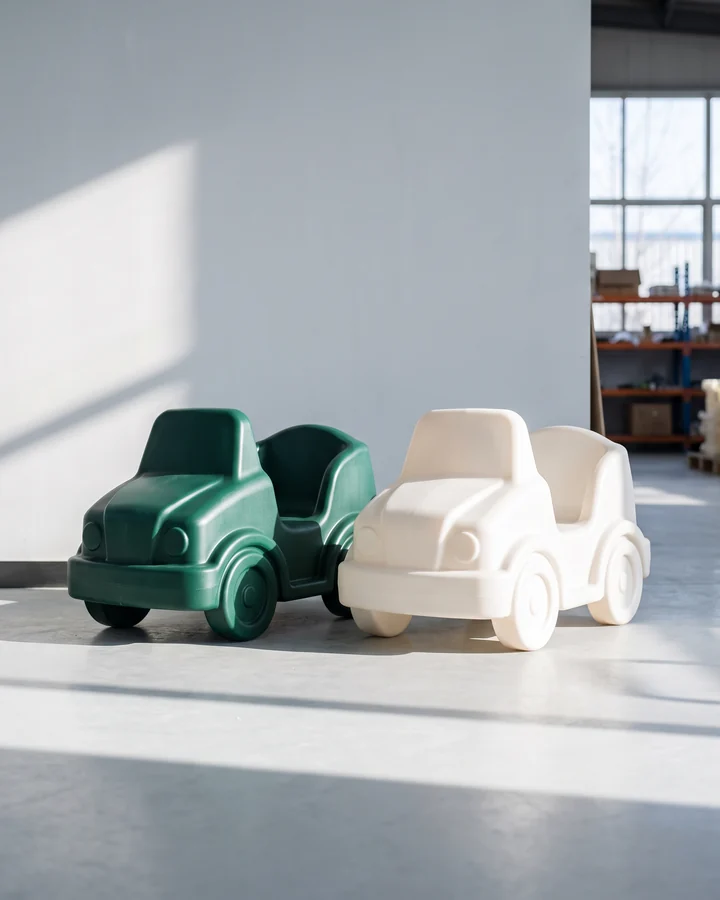
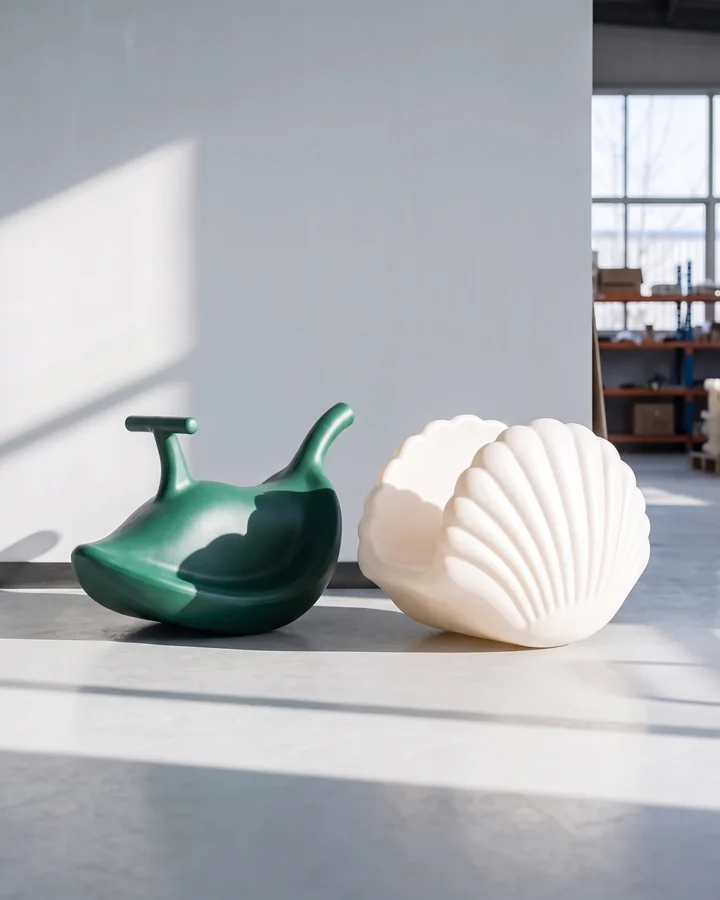
Colors
Bodies and seats in our standard color range or custom colors; steel beams and base plates powder coated in RAL colors to match your play structures.
High-back seats
A high-back inclusive rider for children who need more support. See the high-back rider ↑
Dealer branding
A dealer logo decal on the body. Layouts and data sheets can be issued unbranded or under the dealer's brand, and projects are registered under the dealer's name; more on wholesale playground equipment.
Spring Rider and Seesaw Use Zones, Surfacing and Footings
Use zones
Each spring rider and seesaw gets a around it, drawn to the CPSC handbook values for that piece, or to EN 1176 where your project names it. The design office keeps rocker zones clear of swing zones, slide exits and spinner zones on the layout. Design compliance statements are on playground safety standards.Use zoneThe area around a piece of equipment, set by the standard, that stays clear of other equipment and is covered with impact-attenuating surfacing.
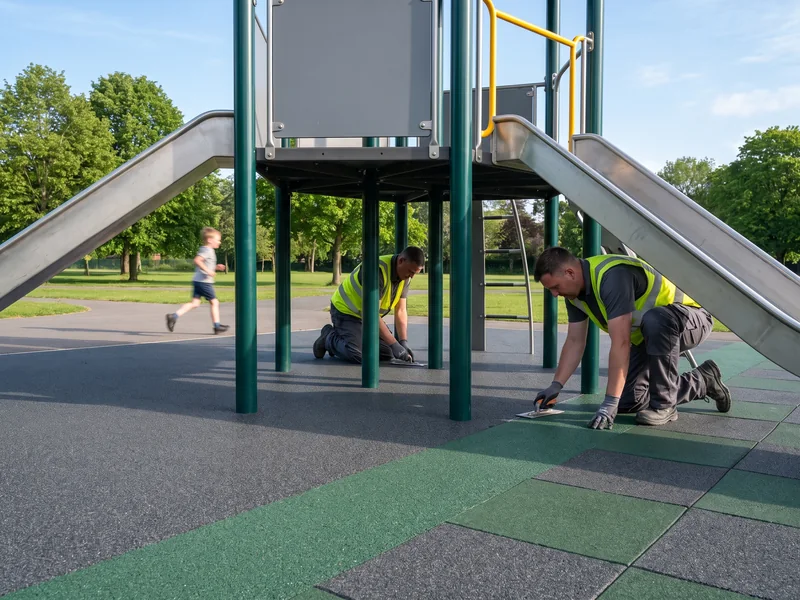
Surfacing
The use zones go into the surfacing thickness zone plan and area table, so impact-attenuating surfacing is laid under every rocker to the drawing. Surfacing materials, tested to ASTM F1292 or EN 1177, are on playground surfacing.
Footings
Installation drawings, videos and an optional on-site supervisor are on playground equipment installation.
- Footing detail drawing
- Anchor plates
- Anchoring hardware
- Numbered parts
- Excavation
- Concrete
- Installation labor
What to Send for a Spring Rider and Seesaw Quotation
- Site plan with dimensions, or the plan of the existing playground the rockers go into
- Age zones: toddler room, 2–5 years, 5–12 years
- Forms and quantities: single, two-seat or four-seat riders, low-seat or high-back riders, classic, four-seat or spring seesaws
- Shapes you prefer: animals, vehicles or theme shapes
- Ground at each position: soil, existing slab or rooftop
- Body colors, and RAL colors for steel parts
- The standard you build to: ASTM F1487 / CPSC handbook or EN 1176
- For replacement springs, bumpers or handles: photos and the
Kpart numbers from your packing list K1-002